A1c · Doctor Visits
A1c Test Next Week and Afraid They'll Say Insulin? Why the Last-Minute Scramble Can't Move the Number
Salads, double walks, skipped dinners, a fasting reading of 97. Marisol did everything in the seven days before her draw. The lab printed 7.8 anyway. Here is why, and the part of the story that starts long before the meter.
By the Blood Sugar Balance editorial desk · October 2026 · 7 min read
"How do I get my A1c down fast? My test is Thursday." Marisol, 61, typed that into her phone at 1 a.m. on a Friday in early October. She is a retired school cafeteria manager from Yonkers, New York, type 2 for seven years, and in April her doctor had said the sentence she'd been replaying all summer: "If we're not under 7.5 by the fall, we need to talk about adding insulin." Her last result had been 7.9. She had six days.

If you have a draw coming up and the word "insulin" has been sitting in your chest since your last visit, you already know this week. The searches at night. The promise that this time you will be perfect. This piece is about why that week almost never shows up on the lab sheet, and what Marisol learned too late to save her October number.
The week everyone has
She did what most of us do. Breakfast became black coffee. Lunch became a bag of spinach with lemon. She walked the block after every meal and again at night. She drank apple cider vinegar in water until her stomach burned, skipped two dinners entirely, and checked her meter five, six times a day.
And it worked, on the meter. By Wednesday her fasting reading was 97. She photographed it and sent it to her sister. "I thought I'd cracked it. I went to the lab Thursday feeling like I'd studied for the exam."
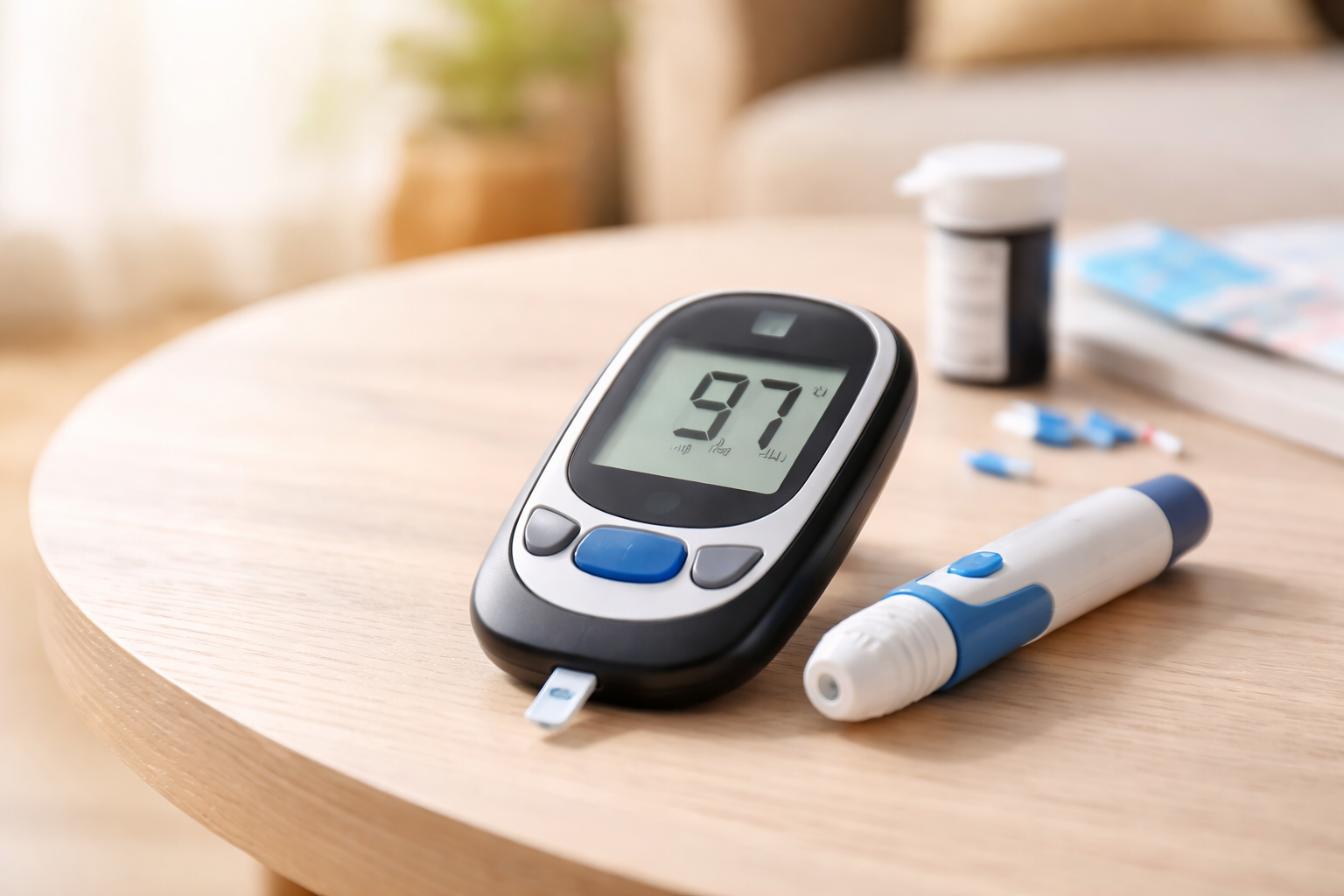
The result came through the patient portal Friday afternoon: 7.8. One tenth of a point. Her doctor's note underneath said they would "discuss next steps" at the follow-up.
A quick word on safety before anything else: skipping meals while you take metformin, a sulfonylurea or insulin can drop you too low, and a crash diet the week before a test can also make your doctor's picture of you less accurate, not more. If you're tempted to starve the number down, call the office first.
Why seven perfect days barely register
An A1c is not a snapshot. Sugar in your blood slowly sticks to hemoglobin, the protein inside your red blood cells, and those cells live roughly three months. The test reads how much sugar is stuck to the whole population of them, young and old. (We wrote about what that average hides in What an A1C Number Does Not Show You.)
Researchers who studied the timing found that the most recent month carries the most weight, roughly half of the result, and the older months fill in the rest. One week is a small slice of that. Even a perfect one gets diluted by the eleven or twelve weeks your red blood cells remember.
In plain English: the meter tells you about this morning. The A1c tells you about the season. You cannot cram for a three-month exam in six days, and that is not a failure of willpower. It's arithmetic.
So the real question was never "how do I get my A1c down fast before Thursday." It was "why does my number keep drifting up across whole seasons, even in the months I'm trying?" That question has an uncomfortable answer for a lot of people, and it isn't about the week before the test at all.
What sits upstream of the meter
Every reading you take is the end of a chain. Food comes in, and your body is supposed to send a signal that does two jobs at once: it tells your pancreas to release insulin at the right moment, and it tells your brain you've had enough. That signal has a name you've probably heard on the news lately, usually attached to an expensive injection: GLP-1. Your body makes its own.
When that natural signal fades, two things tend to show up together. The hunger gets louder, especially mid-afternoon and late at night. And the insulin you do make arrives late or doesn't get used well, so the number creeps no matter how carefully you eat. A crash week can muscle past that for a few days. It doesn't fix whatever turned the signal down.
That's where Marisol's sister came in. A month earlier she had forwarded a long presentation from a physician with thirty years in medicine, whose own wife followed every instruction her doctors gave her for three years and still ended up in the hospital, her number still climbing. He describes the night he stopped asking how to replace what her body wasn't doing, and started asking what was stopping it from doing the job on its own.
He walks through the study that changed his thinking, the short morning routine he built around his wife's kitchen, and why it isn't the honey-and-cinnamon trick that keeps circulating online. We're not going to summarize the routine here. He lays it out step by step, and it's the first explanation Marisol heard that matched the shape of her last three years, not just her last six days.
Dreading the next draw?See what the doctor looked at upstream of the number →When to call your doctor instead of reading another article
If your fasting readings are rising week after week, if you're thirsty all the time, losing weight without trying, or your vision blurs, get an appointment now rather than waiting for the scheduled draw. And if insulin is recommended, it is not a punishment or a moral grade. It's a tool. Never stop or skip a prescribed medicine on your own, and talk to your doctor before adding anything meant to affect blood sugar.
What Marisol started the Monday after
She watched the presentation her sister had sent, all of it, the weekend after the 7.8. "I'd skipped it in September because it was an hour long. Then I'd spent an hour a night that week searching how to lower my A1c overnight. Same hour, wrong place."
At the end of it is a small bottle of drops meant to support the body's own blood sugar balance between meals, which is the stretch the A1c is actually built from. The one she and her sister now keep in the kitchen is Glyco Barrier.
She didn't order that night. She printed the label, circled every ingredient, and took the page to her pharmacist to check against her metformin. What tipped her was the timeline. "It wasn't promising me Thursday. It was talking about months. After that week, that was the first thing anyone said to me that sounded honest."

What she circled on the label
- Chromium picolinate. A mineral studied for how well the body responds to its own insulin, the late-arriving part of the chain.
- Gymnema sylvestre leaf. A traditional herb for healthy glucose metabolism, long associated with quieting the pull toward sweets.
- Green tea leaf. Antioxidants and gentle metabolic support.
- Coleus forskohlii root. Supports how the body uses stored fuel.
- Maca root. Traditionally used for steadier energy through the day, so the afternoon doesn't end at the fridge.
The calendar she's keeping this time
- Week 1. Drops morning and evening, normal meals, no crash diet. She wrote "patience" on the calendar.
- Weeks 2 and 3. The 9 p.m. standoff with the fridge got quieter. Not gone. Quieter.
- Month 1. More fasting readings under her old average than over it, without skipping a single dinner.
- Months 2 and 3. The stretch that actually builds the next A1c. Her follow-up draw is in January, a full season after she started, which is exactly the point.
Why so slow? Because the test is slow. Anything aimed at how your body handles sugar between meals has to run across most of a red blood cell's lifetime before the lab can see it, and the company frames results around weeks of steady use. Individual results vary.
It may suit you if you have type 2 or prediabetes, your A1c has drifted up across several visits, and you're tired of fighting the number one panicked week at a time. Skip it or ask your doctor first if you have type 1, you're on insulin or another glucose-lowering medicine, or you're pregnant or nursing.
The order page shows a 60-day satisfaction promise from the date of purchase. Marisol's reasoning: "Sixty days is two-thirds of the clock that test runs on. If I can't tell by then, I get my money back."
Your next draw is three months away, not six daysWatch the presentation Marisol's sister sent her → Sixty days to see it for yourselfSee the drops that replaced her crash week →P.S. At 1 a.m. that Friday, Marisol was asking how to fix a season in six days. If you're doing the same math tonight, the most useful thing you can do before your test may be to start the clock on the next one. Start where she did.
Continue reading How to Lower Your A1c Naturally When Every Diet Has Stopped Working Another reader, another round of diets, and why willpower was never the missing piece.Sources and further reading
Tahara Y, Shima K. Kinetics of HbA1c, glycated albumin, and fructosamine and analysis of their weight functions against preceding plasma glucose level. Diabetes Care, 1995.
American Diabetes Association. Glycemic Goals and Hypoglycemia, Standards of Care in Diabetes, 2026.
National Institute of Diabetes and Digestive and Kidney Diseases. The A1C Test and Diabetes.