Blood Sugar · Type 2
How Do You Reverse Diabetes? Harold Lost 24 Pounds and Got His A1c Under 7. Then It Started Creeping Back
He did what the research says can put type 2 into remission. For a while it worked. What he learned when the number turned around is the part most "reverse diabetes" advice never mentions.
By the Blood Sugar Balance editorial desk · October 2026 · 7 min read
"How do you reverse diabetes?" Harold, 67, asked his doctor that exact question the day his A1c came back 8.1. He wasn't asking how to manage it. He'd watched his father manage it for twenty years, all the way to a wheelchair. "I asked how you get rid of it," he says. "And to her credit, she gave me a straight answer."
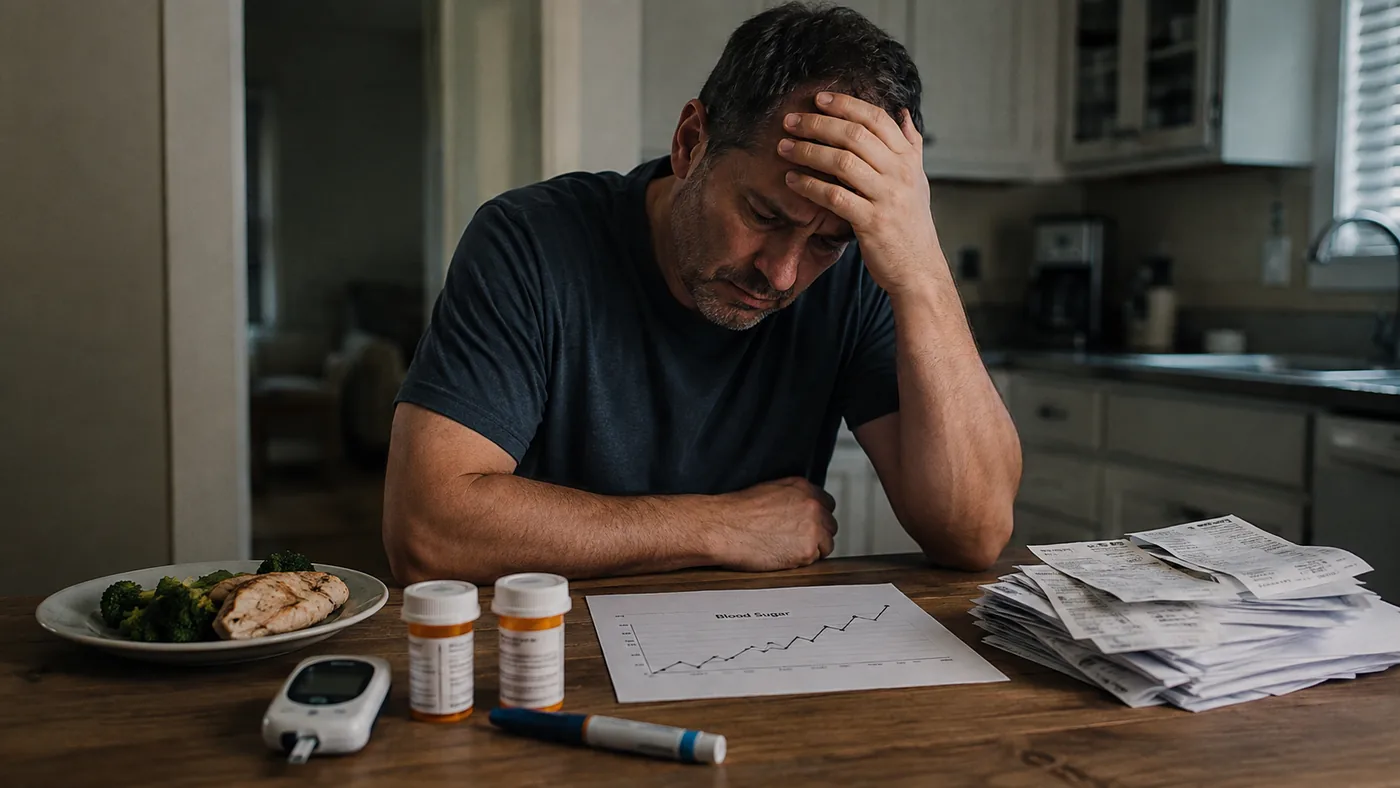
Harold ran a hardware store in Dayton for thirty-four years. He likes things that have a fix. And for about eight months, it looked like type 2 diabetes was one of them. This piece is about what happened in month nine, and why so many people who search the same question end up exactly where he did.
The straight answer: "reverse" usually means remission
Let's start with what's true, because there is real good news in it. For some people with type 2 diabetes, especially in the first several years after diagnosis, the condition can go into what doctors call remission: an A1c back under 6.5% without diabetes medicine, held for at least three months. The best-known evidence comes from a large British trial in which people who lost a substantial amount of weight with a structured low-calorie program were far more likely to reach remission than people who didn't. Roughly half of the participants in the program were in remission after a year, and the more weight someone lost, the better their odds.
That's what Harold's doctor told him. Lose weight, a real amount, and keep it off. Move every day. Cut the sugar and the white starches. It is the most honest answer there is, and if you have type 2 you should hear it from your own doctor too.
So he did it. His daughter built him a meal plan. He gave up the bakery donuts that came with every Saturday shift. He walked the riverfront path every evening. In seven months he lost 24 pounds, and his A1c dropped from 8.1 to 6.9. His doctor shook his hand.
The word to watch: remission isn't the same as cured. It means the number is down, for now. The research is just as clear that for many people it doesn't stay down on its own, even when the weight does.
Month nine
Here is the part nobody had prepared him for. Harold kept the weight off. Every pound. He kept walking, kept the donuts out of the house. And over the next year his numbers slowly turned around anyway. A fasting reading of 118, then 126, then a 3 a.m. wake-up drenched in sweat, reaching for the meter before his feet touched the floor. His next A1c was 7.4.
"I did the homework," he told us. "I did all of it. And the test came back like I hadn't."
If you've been here, you know the feeling. You start to wonder if you cheated without noticing. You start eating less and less and getting hungrier and hungrier. Harold's afternoon cravings came back worse than before he'd lost the weight, a pull toward something sweet around three o'clock that he described as "a dog pulling at the leash."
If your number came back after you did everything rightHear what a physician looks at besides the scale →What weight loss fixes, and what it may not
Weight loss works on one big thing: it takes pressure off the liver and pancreas by clearing out some of the fat that crowds them. That's real, and it's why the first months went so well for Harold.
But how your body handles sugar also depends on a conversation that happens every time you eat. When food arrives, your gut sends a signal that tells your pancreas to release insulin at the right moment, and tells your brain you've had enough. That signal has a name you've probably only heard in commercials for weekly injections: GLP-1. Your body makes its own. And when that natural signal fades, two things tend to happen at once. The insulin you do make doesn't get used as well. And the "I'm full" message gets quieter, so the cravings get louder.
Notice what that describes. A man who kept the weight off, whose sugar crept back anyway, and whose 3 p.m. cravings came back stronger. Harold read that paragraph twice. "That's me," he said. "That's the leash."

The presentation his sister-in-law sent
Harold's sister-in-law, a retired school nurse in Kentucky, had been sending him the same link for months. It was a presentation by a physician with three decades in medicine whose own wife had followed every instruction she was given, year after year, and still watched her A1c climb until she landed in the hospital.
Harold ignored it because it was about an hour long. "I closed the store at nine every night for thirty-four years. I don't sit for an hour." After the 7.4, he sat for an hour.
The doctor talks about the night he stopped asking how to replace what his wife's body had stopped doing and started asking what was keeping it from doing that job on its own. He walks through a study of identical twins, same genes, same upbringing, only one with type 2, that changed how he thought about the whole problem. He describes a short morning routine built around an oil mentioned many times in Scripture, and he is particular about which kind. And he explains why it isn't the honey-and-cinnamon drink half of Facebook has been passing around. We won't give away his routine here. It's his to explain, and it makes more sense in his own words.
What Harold said when it ended: "Nobody told me the weight was only half the job."
You already lost the weightWatch the hour Harold finally sat still for →Before you change anything
Keep doing what your doctor told you. Weight loss, daily movement and fewer refined carbs are still the foundation, and remission is a real possibility for some people. If your readings are climbing fast, you're constantly thirsty, losing weight without trying, or your vision blurs, call your doctor now. Never stop or skip a prescribed medicine, and if you're on insulin or any pill that lowers blood sugar, ask before adding anything.
What sits on his counter now
At the end of that presentation is a bottle of drops meant to support the body's own blood sugar balance between meals, the stretch where Harold's numbers kept slipping. The one in his kitchen is Glyco Barrier.
He didn't order that night. Harold sold tools for a living and has never bought anything without reading the specs, so he printed the label and took it to his pharmacist, who checked it against his metformin, said it wouldn't interfere, and told him to keep his doctor in the loop. He does.
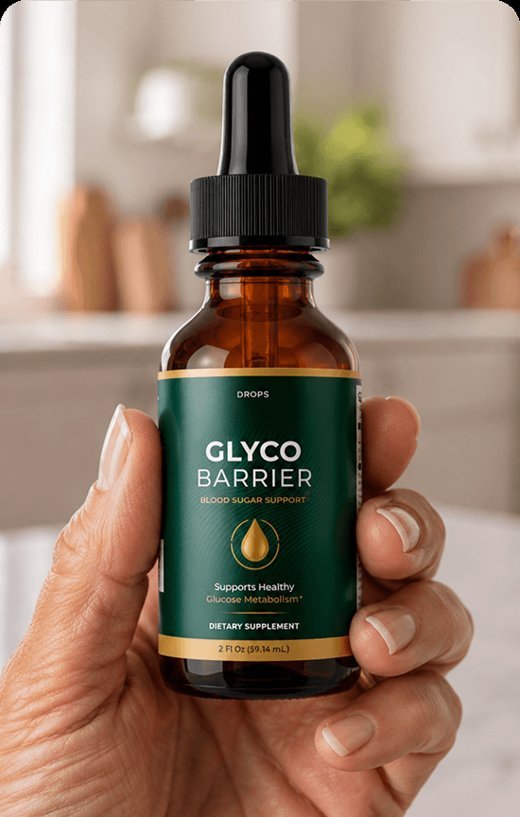
What he circled on the label
- Chromium picolinate. A mineral studied for how well the body responds to its own insulin, the slow part of Harold's mornings.
- Gymnema sylvestre leaf. A traditional herb for healthy glucose metabolism, long associated with quieting the pull toward sweets. "The leash," he wrote in the margin.
- Green tea leaf. Antioxidants and gentle metabolic support.
- Coleus forskohlii root. Supports how the body uses stored fuel.
- Maca root. Traditionally used for steadier energy through the afternoon.
How the weeks went
- Week 1. Drops morning and evening, same meals, same walk. Nothing he could measure, and he didn't expect anything.
- Weeks 2 and 3. The three o'clock pull came later in the day, and some days he walked past the kitchen without noticing it.
- Month 1. No more 3 a.m. sweats in the last two weeks of the month. His fasting readings stopped climbing.
- Months 2 and 3. The stretch that actually shows on an A1c. His next draw is in January, and he's put it on the calendar instead of avoiding it.
Why so slow? Because anything aimed at how your body handles sugar between meals needs weeks of steady use before a lab test can see it, and the company frames results that way. Individual results vary.
It may suit you if you have type 2 or prediabetes, you've done the diet and the walking, and your number turned around anyway. Skip it or ask your doctor first if you have type 1, you're on insulin or another glucose-lowering medicine, or you're pregnant or nursing.
The order page shows a 60-day satisfaction promise from the date of purchase. Harold's arithmetic: "Two months. If the number doesn't care, I get my money back. I've lost more than that on a bad shipment of snow shovels."
Sixty days to work on the other halfSee the drops by Harold's back door →P.S. Harold still has the note from the day he asked how you reverse diabetes. His doctor wrote "remission" on it and underlined it. Under that, in his own handwriting, he's added: "and the signal." If you lost the weight and the number came back anyway, start with the presentation his sister-in-law kept sending.
Continue reading "What Foods Will Lower My Blood Sugar?" Ernesto Changed Every Plate in the House. The Meter Still Said 165 Another reader, the same plate giving two different numbers, and the part of the question no food list answers.Sources and further reading
Lean MEJ, et al. Primary care-led weight management for remission of type 2 diabetes (DiRECT): an open-label, cluster-randomised trial. The Lancet, 2018.
Riddle MC, et al. Consensus Report: Definition and Interpretation of Remission in Type 2 Diabetes. Diabetes Care, 2021.
Nauck MA, Meier JJ. Incretin hormones: their role in health and disease. Diabetes, Obesity and Metabolism, 2018.